
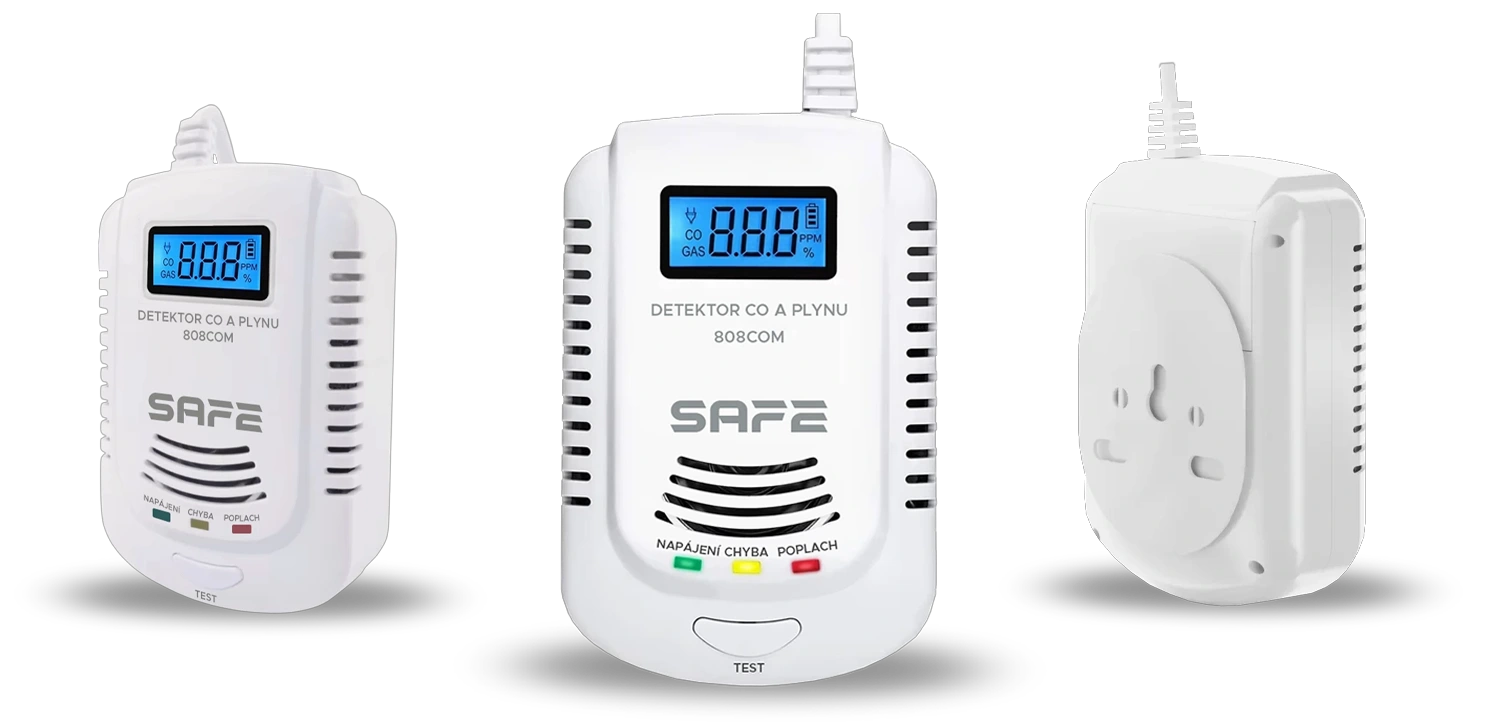
SAFE 808COM is an intelligent combined detector equipped with the latest second-generation electrochemical and semiconductor multifunction sensor technology for the detection of, and early warning against, carbon monoxide (CO) and almost all flammable, explosive gases (natural gas, methane, propane, butane). The device excels in stability, high sensitivity and the long life of its pair of sensors. It is ideally suited to reliable detection of gas or CO leaks from all domestic gas appliances and gas boilers.
Foreword
General
This user manual describes the installation, functions and operation of the SAFE 808COM standalone combined carbon monoxide (CO) and flammable gas detector with voice warning and a colour LCD display (hereinafter the “detector”). The detector has no Hub or mobile app and works completely autonomously – it signals danger with its own acoustic and visual signalling directly on the device. Read the manual carefully before using the device and keep it for future reference.
Safety instructions
The following signal words may appear in the user manual:
| Signal word | Meaning |
|---|---|
| NEBEZPEČÍ | Indicates a high potential hazard which, if not avoided, may result in death or serious injury. |
| VAROVÁNÍ | Indicates a medium or low potential hazard which, if not avoided, could result in minor or moderate injury. |
| UPOZORNĚNÍ | Indicates a potential risk that could lead to damage to property, loss of detection functionality or an unpredictable result. |
| TIP | Provides methods to help you solve a problem or save time. |
| POZNÁMKA | Provides additional information, such as emphasis or a supplement to the text. |
Revision history
| Version | Revision content | Release date |
|---|---|---|
| V1.0.0 | First release. | September 2026 |
| V1.0.1 | Colours according to the FireSAFE brand (red). | October 2026 |
| V1.0.2 | Internal notes from the manual compilation removed. | October 2026 |
About the manual
- The user manual serves as a reference only. Minor differences may occur between the information provided and the product.
- We are not liable for damage resulting from use of the product in a manner that is not in accordance with the instructions in the user manual.
- The manual will be updated in line with current laws and regulations of the relevant countries. The manual is for information purposes only. The electronic and printed versions may differ in minor details.
- Printing errors or deviations may occur in the description of functions and technical data. In case of doubt or dispute, we reserve the right of final interpretation.
- All trademarks, registered trademarks and company names in the manual are the property of their respective owners.
- If any problems occur while using the device, visit our website, or contact your supplier or customer service.
Important precautions and warnings
This section contains information on the correct handling of the product, risk prevention and prevention of property damage. Read it carefully before using the device and follow the instructions provided while using it.
Operating requirements
- Before use, make sure the device's power supply is working correctly – the detector requires a constant 230 V mains power supply to operate and is not capable of detection without it.
- Do not pull the device's power cable out of the socket while it is in operation.
- Use the device only within the range of the rated supply voltage and rated power consumption.
- Transport, use and store the device under the permitted humidity and temperature conditions.
- Prevent liquids from splashing or dripping onto the device. Make sure there are no objects filled with liquid on the device, to prevent liquids from entering it.
- Do not disassemble the device – there is a risk of electric shock or failure of the device.
Installation requirements
- Plug the device directly into a permanently installed 230 V mains socket within reach of the power cable – do not use an extension cable with a shared load or a multi-socket adapter.
- Strictly observe local electrical safety standards and make sure that the mains voltage is stable and meets the power supply requirements of the device.
- When working at height, follow all safety procedures and use the required protective equipment.
- Do not expose the device to direct sunlight or sources of heat.
- Install the device in a well-ventilated place and do not block the intake grilles on its sides.
- Connect Class I electrical appliances to a socket with protective earthing.
What to do in the event of an alarm
The SAFE 808COM detector monitors two types of hazard simultaneously – a carbon monoxide (CO) leak and a flammable gas leak. When the threshold concentration is exceeded, it triggers acoustic signalling from the siren (85 dB), flickering of the red ALARM LED indicator and a voice warning; the measured concentration is shown on the display.
Carbon monoxide (CO) alarm
- Go out into fresh air immediately – outside or to an open door or window. Count the people present to make sure that nobody has stayed inside.
- Do not re-enter the affected premises until the emergency services have arrived, the premises have been ventilated and the detector has returned to its normal state.
- Call the emergency number 112, or a local inspection technician.
- Never ignore the warning signalling and do not repeatedly start the source of CO until the problem has been resolved.
Flammable gas alarm
- Open the windows, ventilate the room and prevent the gas from igniting in the area.
- Shut off the gas supply and all gas appliances.
- Extinguish all sources of fire and do not use anything that could cause a gas explosion (switches, telephone, lighters, etc.).
- Do not switch any electrical equipment on or off, including the detector.
- Do not use a telephone at the site of the gas leak.
- If the signalling does not stop and the cause of the leak is not obvious, leave the area and call the emergency line 112.
Time to CO alarm activation according to EN 50291
| CO concentration | Time to alarm |
|---|---|
| 50 ppm | 60 to 90 min |
| 100 ppm | 10 to 40 min |
| 300 ppm | within 3 min |
About flammable and explosive gases and carbon monoxide
Carbon monoxide (CO)
Carbon monoxide is a colourless, poisonous gas with no taste or smell which, when inhaled, adversely affects the blood's ability to carry oxygen and can have fatal consequences. It is produced by incomplete combustion of carbon-based fuels – typical sources are wood-burning stoves, gas heaters and fireplaces, gas cookers, appliances burning oil or coal, portable gas heaters, blocked flue passages and chimneys, or exhaust fumes from garages.
| CO concentration (ppm) | Effects on adults |
|---|---|
| 100 ppm | Mild headache, nausea, fatigue (flu-like symptoms) |
| 200 ppm | Dizziness and headache after 2–3 hours |
| 400 ppm | Nausea, frontal headache, drowsiness, disorientation and rapid heartbeat; life-threatening after 3 hours of exposure |
| 800 ppm | Severe headache, convulsions, failure of vital organs; death may occur within 2–3 hours |
Natural gas and methane – lighter than air
Natural gas is supplied to households by pipeline and is the main source of energy for heating and cooking. It is a fossil fuel containing almost exclusively methane, which is much lighter than air and rises upwards when it escapes. In the case of natural gas or methane, the detector must therefore be installed close to the ceiling.
Propane, butane, LPG – heavier than air
Propane (classed together with butane as liquefied petroleum gases, LPG) is most often supplied in liquid form in pressurised cylinders and is used mainly where natural gas is not available. Unlike natural gas, propane is much heavier than air and stays low to the ground when it escapes. In the case of propane, butane or LPG, the detector must therefore be installed close to the floor.
Explosive limits
- Lower explosive limit (LEL) – the lowest concentration of a flammable gas in a mixture with air at which the mixture can still be ignited.
- Upper explosive limit (UEL) – the highest concentration of a flammable gas in a mixture with air above which the mixture becomes non-explosive owing to a lack of oxygen.
For example, for natural gas the lower explosive limit is approximately 4.3 % by volume and the upper approximately 15 % by volume – an explosion can therefore occur at concentrations between these values.
Functional elements
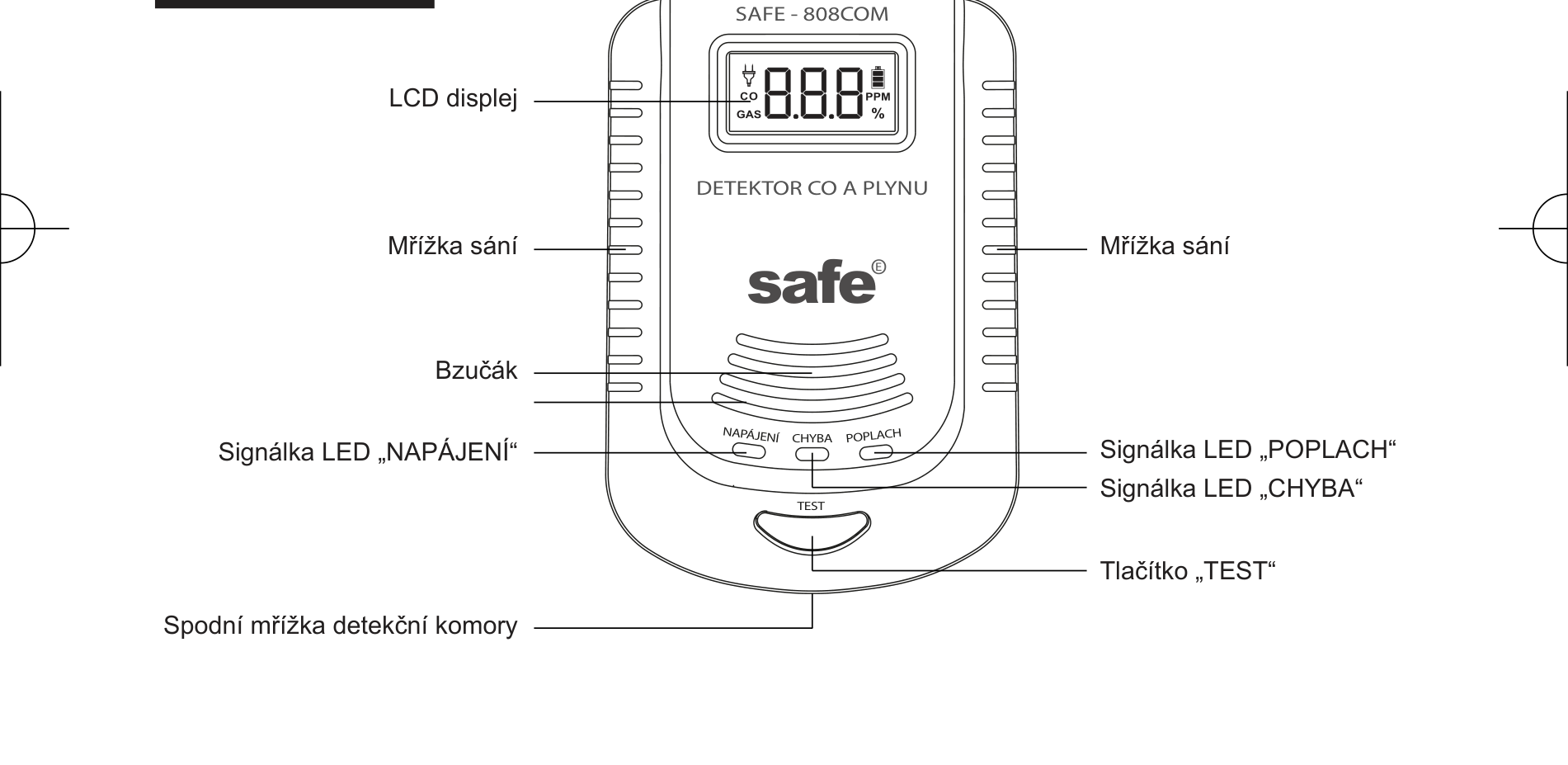

- Intake grilles (on both sides of the housing) – allow air to flow to the sensor inside the detection chamber.
- Buzzer – provides acoustic (85 dB siren) information on the states of the individual device modes, accompanied by LED visual signalling.
- LCD display – shows the current power status, the measured gas or CO concentration and the backup battery status.
- “POWER” LED indicator (green) – lit continuously when connected to the 230 V mains.
- “FAULT” LED indicator (yellow) – lit continuously when the device has a fault.
- “ALARM” LED indicator (red) – flashes rapidly when a dangerous concentration is detected.
- TEST button – used to verify the function of the acoustic and visual signalling.
- Power cable with plug for a 230 V socket (length 1.35 m) – a fixed part of the device, cannot be disconnected.
- Backup battery compartment (rear) – for an optional 9 V NiMH battery (not included in the package).
Principle of operation
The SAFE 808COM continuously tests the air for a dangerous concentration of gases using a second-generation semiconductor sensor for detecting combustible and explosive gases and an electrochemical sensor for detecting carbon monoxide (CO). The device is controlled by a microprocessor and signals a leak both visually and acoustically. The multifunction sensor complies with the European safety standards EN 50194 (combustible and explosive gases) and EN 50291 (carbon monoxide) and is factory-calibrated, with no need for further periodic service calibration.
The detector is configured to raise an alarm before the concentration limit is reached which, if it were to rise further, would pose a risk to health and property – regardless of whether the gas is odorised (enriched with a characteristic smell) or not.
Voice warning
The detector informs the user in a human voice (in Czech) about the current device status, for example: “Welcome, this is the carbon monoxide and combustible gas detector, please wait 3 minutes while the device initialises.” If danger is detected, the acoustic alarm is accompanied by the repeated voice message “Attention please, carbon monoxide leak!” or “Attention please, gas leak!”.
TEST function
The TEST button is used to artificially trigger an alarm state and makes it possible to verify the operability of the internal circuits, the acoustic signalling and the LED visual signalling.
Signalling
| LED indicator | Acoustic signal | Device mode |
|---|---|---|
| Green lit continuously | No signalling | Connected to the 230 V mains, normal operating mode |
| Red flashing rapidly (ALARM) | 85 dB siren + voice warning | Alarm – a dangerous concentration of CO or combustible gas has been detected. Follow the procedure in the chapter What to do in the event of an alarm |
| Yellow lit continuously (FAULT) | Acoustic buzzer signal | Device fault – the detector is no longer capable of reliable detection and must be replaced |
| All 3 LEDs flash briefly | Short acoustic alarm | Function test (by pressing the TEST button) |
Choosing the installation location
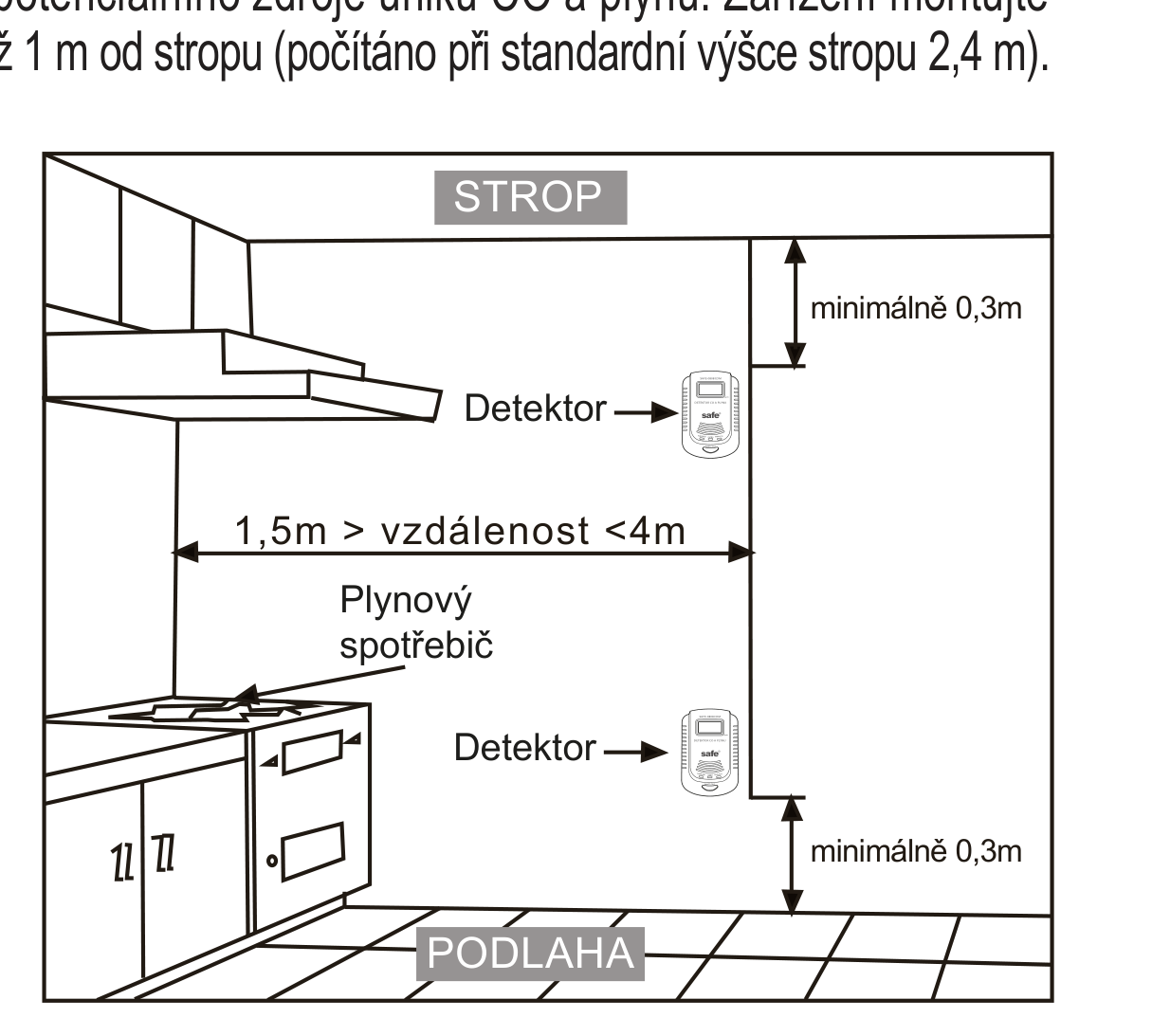
The detector must be installed by a competent person. The correct placement depends on the type of gas to be detected:
- For gases lighter than air (CO, natural gas, methane), mount the detector on the wall at most 0.3 to 1 m from the ceiling (based on a standard ceiling height of 2.4 m).
- For gases heavier than air (propane, butane, LPG), mount the detector close to the floor, from 0.3 to 1 m.
- Place the detector at a distance of from 1.5 m to 4 m from the potential source of a leak (gas appliance, boiler, cylinder).
- Orient the intake grilles in the expected direction of air flow.
- Take into account the length of the power cable (1.35 m) and the availability of a 230 V socket at the installation site.
Where not to install the detector
- Too close to a gas appliance (risk of false alarms) – keep a minimum distance of 1.5 m.
- In places with cooking fumes – fumes may trigger false alarms or damage the sensor.
- In room corners, near doors and windows, near fans or air-conditioning equipment.
- In rooms with strong draughts or that are permanently ventilated.
- In rooms that are too cold (below 0 °C) or too warm (above 50 °C).
- In an area with swirling dust or air saturated with grease.
- In the immediate vicinity of fluorescent light fittings (including compact fluorescent lamps) – they may affect the operation of the detector through electrostatic discharges and high-frequency radiation.
Plugging into a socket
The SAFE 808COM detector is intended for mains power only AC 230 V / 50–60 Hz via the integrated plug at the end of the power cable (length 1.35 m). The detector has no separate power adapter or replaceable cable.
- Fix the detector to the wall according to the chapter Wall mounting.
- Plug the power cable plug into a 230 V mains socket. The green “POWER” LED indicator lights up.
- The detector starts automatically and begins initialisation – see the chapter Sensor warm-up and calibration.
Sensor warm-up and calibration
After being plugged into the socket, the detector's sensor needs time to warm up and initialise before it is capable of reliable detection.
- Initialisation time: 180 s (3 minutes) – during this time the device announces the initialisation in progress by voice and the detector does not yet evaluate the gas or CO concentration.
- Once the initialisation period has elapsed, the green “POWER” LED stays lit continuously, the AC power icon appears on the display and the device automatically switches to normal detection operating mode.
- Response time: max. 20 s from the moment the concentration exceeds the alarm trigger threshold.
Wall mounting
The detector is intended for wall mounting using the supplied screws, into pre-drilled holes with wall plugs.
- Choose a suitable location according to the chapter Choosing the installation location – take into account the type of gas to be detected and the availability of a 230 V socket.
- According to the spacing of the mounting holes on the back of the detector (or the rear mounting bracket), mark two points on the wall and drill the mounting holes.
- Insert wall plugs into the drilled holes and screw the detector (or its mounting bracket) to the wall using the supplied screws.
- Plug the detector into a 230 V socket according to the chapter Plugging into a socket.
- Test the function of the device by pressing the TEST button (see the chapter Functionality test).
Functionality test
After installation, after every handling of the device and also regularly at least once a week verify the function of the detector with the TEST button.
- Make sure the detector is connected to the 230 V mains – in operating mode the green “POWER” LED indicator is lit continuously. If it is not lit, check the connection; if it is still not lit when correctly connected, the detector must be replaced immediately.
- Briefly press the button TEST.
- Verify that the acoustic signalling of the buzzer (siren) starts, accompanied by flickering of the red “ALARM” LED indicator.
- Check that the acoustic signal is clearly audible even from adjacent rooms.
Power failure and backup battery
Semiconductor sensors for the detection of flammable and explosive gases require a constant power supply from the electrical mains. The detector is therefore additionally equipped with an integrated fast-charging converter and a compartment for an optional backup battery 9 V NiMH, which provides temporary protection for a certain interval in the event of a power failure. The battery is not included in the package as standard.
| Parameter | Value |
|---|---|
| Backup battery type | NiMH 9 V (optional, not included in the package) |
| Operating time on the backup battery | operating mode 100 min / alarm 10 min |
| Recommended battery types | NiMH Energizer PowerPlus, NiMH Duracell 170, NiMH GP 20R8H |
Installing or replacing the backup battery
- Unplug the power cable plug from the 230 V electrical mains socket.
- Open the battery compartment on the back of the detector.
- If replacing, remove the old battery and dispose of it appropriately as recommended by the battery manufacturer.
- Insert a new 9 V NiMH battery – observe the polarity marked in the battery compartment.
- Close the battery compartment cover.
- Test the detector with the TEST button before reconnecting it to the mains.
Maintenance
- Verify the sound signalling, the LED indicators and the power supply once a week by pressing the TEST button.
- Once a month, clean the detector and the intake grilles with a vacuum cleaner to remove accumulated dust; alternatively, clean them by blowing on them gently.
- Never use detergents or solvents for cleaning – chemicals may permanently damage the detector or temporarily contaminate the sensor.
- Do not use air fresheners, hair sprays, paints or other aerosols near the detector.
- Do not paint the device – paint could seal the grille openings and adversely affect the function of the sensor.
- The device cannot be disassembled – opening it voids the warranty.
End of life
The expected life of the device, with correct handling and maintenance, is min. 5 years. After this period has elapsed, or if the detector does not pass the test with the TEST button or its own diagnostics report a fault (continuously lit yellow “FAULT” LED), the unit must be replaced with a new one without delay – otherwise the device is no longer capable of reliably detecting a dangerous gas concentration.
Technical specifications
| Detection | |
| Model | SAFE 808COM |
| Display | Colour multifunction LCD display |
| Sensor technology (gas) | Second-generation semiconductor sensor, catalytic combustion |
| Sensor technology (CO) | Electrochemical CO sensor |
| Sensor sensitivity | Corresponds to a concentration of 6 % LEL / 3,000 ppm LEL |
| Alarm – combustible gas | ≥ 2,500 ppm (0.25 % LEL) |
| Alarm – CO | ≥ 50 ppm (60–90 min according to EN 50291) |
| Tolerance of displayed values | Ambient 27 °C ± 12 °C (80 °F ± 10 °F); atmospheric pressure ± 10 %, 40 % ± 3 % RH |
| Initialisation time | 180 s |
| Response time | Max. 20 s |
| Signalling | Acoustic (85 dB siren) and visual (3× LED indicator) |
| Permissible concentration exceeded | 85 dB acoustic alarm accompanied by the voice warning “Attention please, carbon monoxide leak!” or “Attention please, gas leak!”, a visual indication by the red LED and the detected concentration shown on the display |
| LED signalling indication | AC power: green LED indicator lit continuously |
| Alarm | Red LED indicator flashing rapidly |
| Fault | Yellow LED indicator lit continuously |
| Power supply | |
| Mains power | AC 230 V / 50–60 Hz |
| Backup power | 9 V NiMH battery (optional – battery not included) |
| Operating time on the backup battery | operating mode 100 min / alarm 10 min |
| Maximum consumption | In alarm mode 3.5 W / in standby mode 2.5 W |
| Power cable length | 1,35 m |
| General | |
| Mounting method | Wall-mounted (screws included in the package) |
| Type of installation | Indoor |
| Ingress protection | IP20 |
| Operating temperature | 0 °C to +50 °C |
| Operating humidity | 10 % to 95 % relative humidity, non-condensing |
| Storage conditions | Temperature: −10 °C to +50 °C |
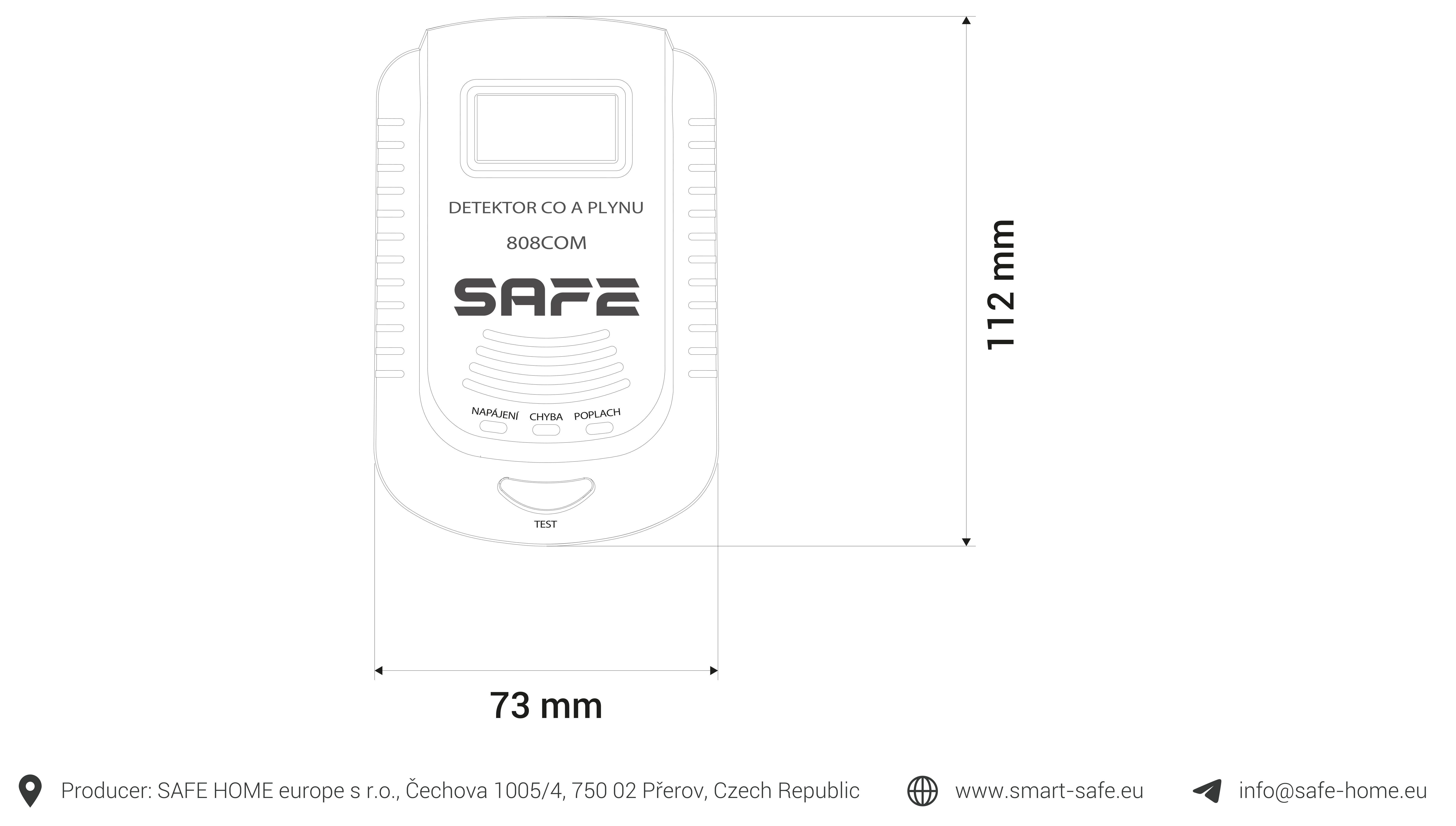
| Product dimensions | 73 × 112 × 42 mm |
| Product weight | 160 g |
| Certification | EN 50194-1:2009; EN 50291-1:2010 |
| Declaration of Conformity | CE |
| Device life | Min. 5 years |
| EAN code | 0703123016315 |
| Warranty | 24 months |
Package contents
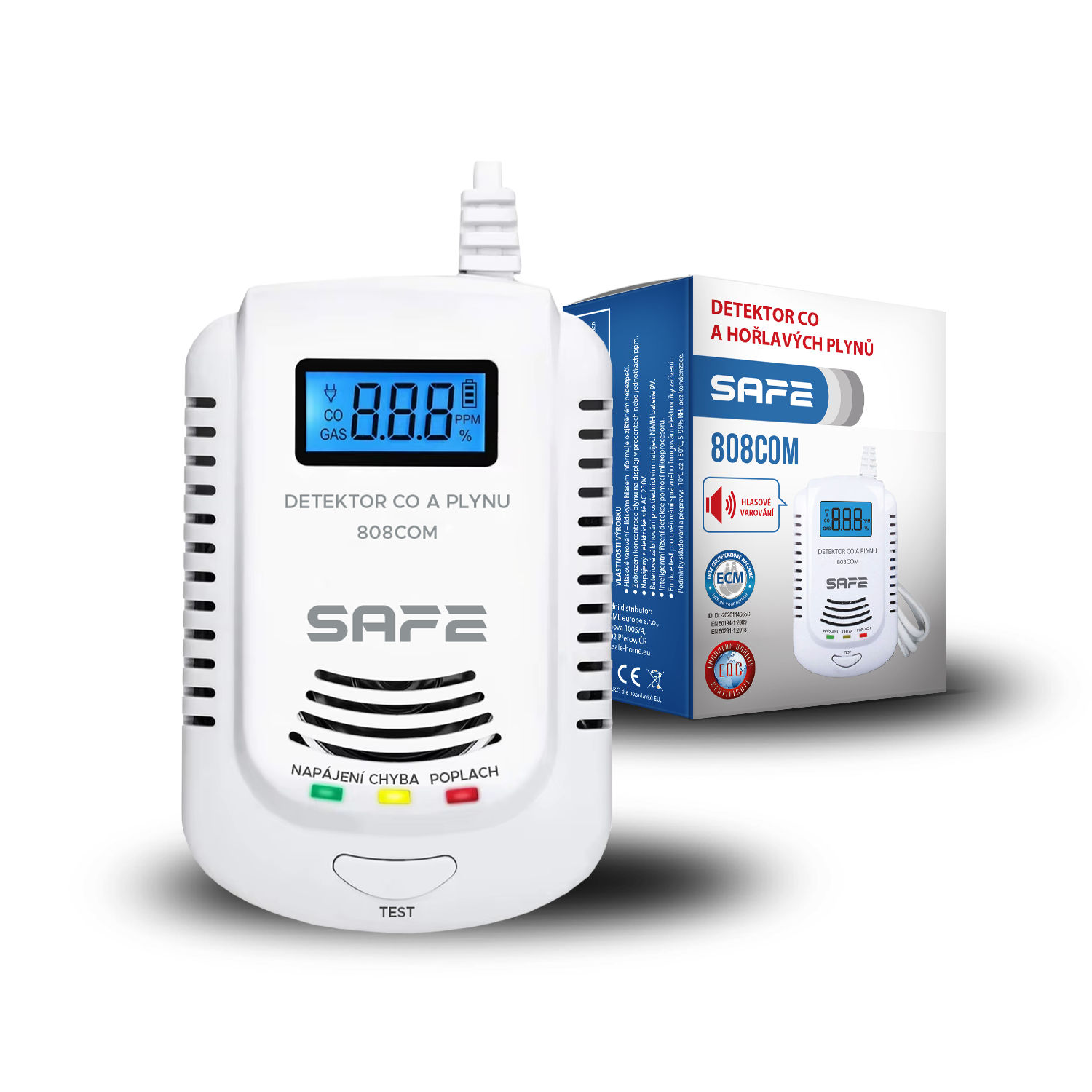
- SAFE 808COM detector – 1 pc
- Mounting screws – 2 pcs
- User manual – 1 pc
Safety notices
- Read these instructions carefully before use and keep them for future reference and for any subsequent user.
- Under no circumstances ignore the detector's alarm – such behaviour could lead to serious injury or death.
- The detector requires a constant 230 V mains power supply to operate – without power (once any backup battery is depleted) it is not functional.
- The device detects only carbon monoxide (CO) and combustible/explosive gases – it does not detect smoke, flame, temperature or other gases. It does not replace the installation and maintenance of an adequate number of smoke alarms in your home.
- Do not attempt to open or disassemble the detector – there is a risk of electric shock, failure or loss of the warranty.
- The product is intended for indoor use in residential premises only. It is not designed for determining compliance with commercial and industrial standards or for installation in hazardous locations.
- Installing this device does not replace the correct installation, use and maintenance of fuel-burning appliances, including adequate ventilation and flue-gas extraction.
- Do not install the detector too close to a gas appliance or in places with cooking fumes.
- Any modifications to the detector may lead to electric shock or prevent it from functioning correctly.
- If there is any sign of a fault (continuously lit yellow “FAULT” LED), contact the manufacturer or supplier and do not use the detector any further.
- Instruct children never to touch the detector, switch it off or otherwise interfere with it. Inform all members of the household of the procedure in the event of an alarm.
- If you use the optional backup battery, keep it out of the reach of children, do not throw it into a fire, and do not crush or cut it – there is a risk of explosion. If you suspect a battery has been swallowed, seek medical help immediately.
- Do not dispose of the product with general municipal waste or burn it – hand it in for recycling in the electrical equipment take-back system.
Warranty
A warranty is provided on the SAFE 808COM device 24 months from the date of sale (excluding the backup battery). The warranty is limited to replacement or repair of the product at the supplier's discretion and does not cover defects caused by failure to follow the instructions in this manual, an accident, inappropriate use, maintenance or handling, or any other manner that is not the result of a defect in materials or workmanship. The warranty applies only to the original consumer who purchased the product and does not affect your statutory rights.
In case of problems with the device, first contact technical support – most situations can be resolved remotely.
Need help?
SAFE HOME europe technical support:
E-mail: info@safe-home.eu · Telephone: (+420) 581 222 262
Web: www.smart-safe.eu