
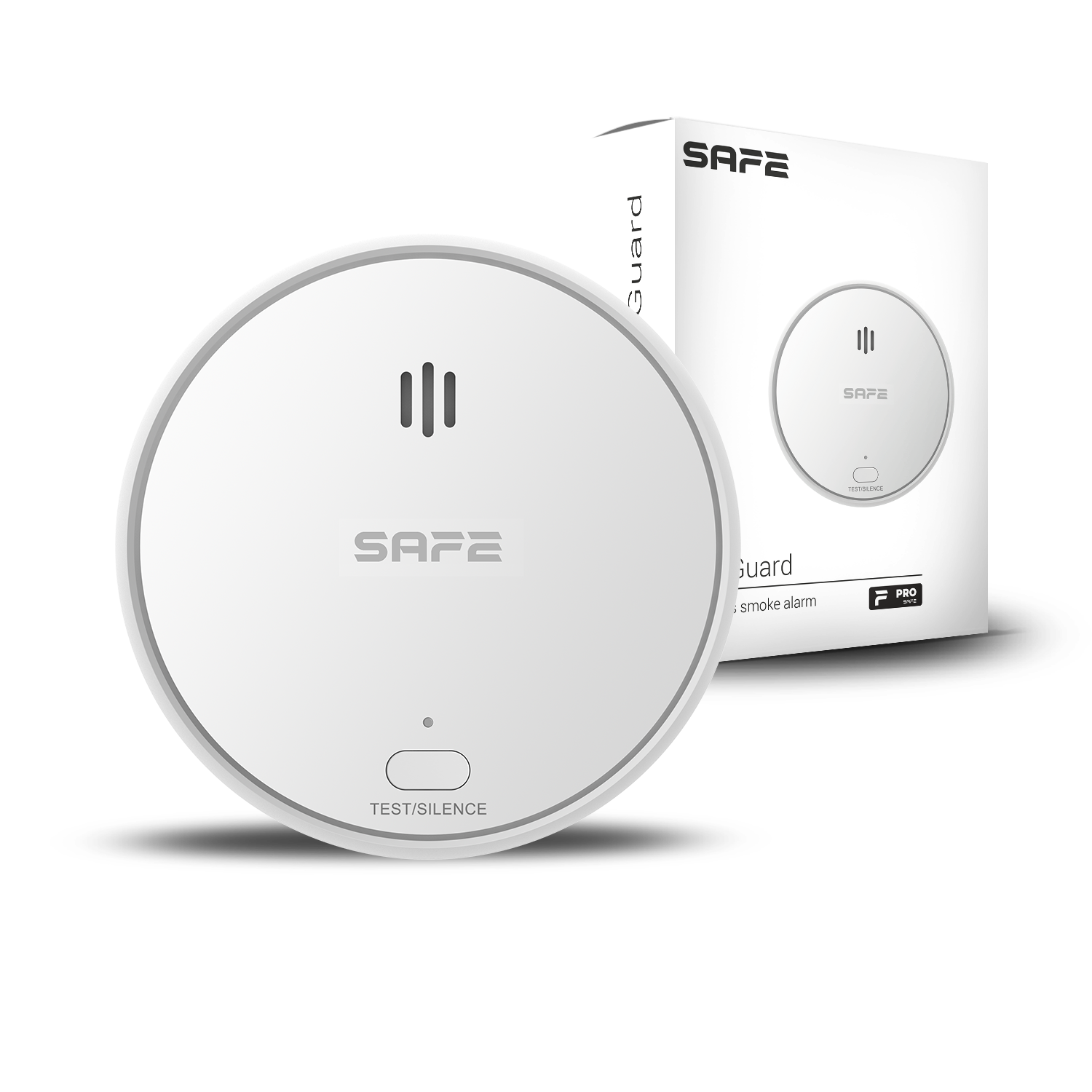
Fire Guard is a wireless smoke fire detector with a photoelectric dual-spectrum, dust-resistant sensing chamber and SIC technology for temporarily silencing the alarm using an IR remote control. It can operate as part of the SAFE security system with hub support, or completely autonomously. The detector stands out for its fast response to danger detection combined with high sensitivity, stable performance, and maximum resistance to false alarms.
Preface
General
This user manual introduces the installation, functions, and operation of the wireless smoke detector (hereinafter the "detector"). Before using the device, read the manual carefully and keep it for future reference.
Safety Instructions
The following signal words may appear in the user manual:
| Signal Word | Meaning |
|---|---|
| DANGER | Indicates a high potential hazard that, if not avoided, may result in death or serious injury. |
| WARNING | Indicates a medium or low potential hazard that could cause minor or moderate injury if not avoided. |
| CAUTION | Indicates a potential risk that could lead to property damage, data loss, reduced performance, or an unpredictable outcome. |
| TIP | Provides methods to help you solve a problem or save time. |
| NOTE | Provides additional information, such as emphasis and supplementary text. |
Revision History
| Version | Revision Content | Release Date |
|---|---|---|
| V1.0.0 | First release. | August 2026 |
Privacy Notice
As a device user or data controller, you may collect personal data of others, such as their face, fingerprints, and license plate number. You must comply with local privacy laws and regulations to protect the legitimate rights and interests of other people by implementing measures that include, among others: providing clear and visible identification to inform people of the existence of the monitored area and providing the required contact information.
About the Manual
- The user manual serves as a reference guide only. There may be minor differences between the information provided and the product.
- We are not liable for any damage resulting from using the product in a manner that does not comply with the instructions in the user manual.
- The manual will be updated according to the latest laws and regulations of the relevant jurisdictions. For detailed information, refer to the printed user manual, scan the QR code, or visit our official website. The manual is for reference purposes only. There may be minor differences between the electronic and paper versions.
- All designs and software are subject to change without prior written notice. Due to product updates, certain differences may occur between the product and the information in the manual. Customer service will provide you with the latest version of the software and supplementary documentation.
- There may be printing errors or discrepancies in the description of functions, operations, and technical data. In the event of doubt or dispute, we reserve the right of final explanation. If the manual (in PDF format) cannot be opened, update your reader software or try a different common reader software.
- All trademarks, registered trademarks, and company names in the manual are the property of their respective owners.
- If you encounter any problems while using the device, visit our website or contact your supplier or customer service.
- In the event of ambiguity or dispute, we reserve the right of final explanation.
Important Safeguards and Warnings
This section contains information on the proper handling of the product, risk prevention, and prevention of property damage. Read it carefully before using the device and follow the instructions provided when using it.
Operating Requirements
- Before use, make sure the device's power supply is working properly.
- Do not unplug the device's power cable while it is switched on.
- Use the device only within its rated power range.
- Transport, use, and store the device within the permitted humidity and temperature conditions.
- Prevent liquids from splashing or dripping onto the device. Make sure there are no liquid-filled objects on the device, to prevent liquid from entering it.
- Do not disassemble the device.
Installation Requirements
- Before switching on, connect the device to the power adapter.
- Strictly comply with local electrical safety standards and make sure the voltage in the area is stable and matches the device's power requirements.
- Do not connect the device to more than one power source. Otherwise, the device could be damaged.
- When working at heights, follow all safety procedures and use the required protective equipment.
- Do not expose the device to direct sunlight or heat sources.
- Do not install the device in damp, dusty, or smoky locations.
- Install the device in a well-ventilated location and do not block its ventilation.
- Use the power adapter or power supply provided by the device manufacturer.
- The power supply must meet the ES1 requirements of IEC 62368-1 and must not exceed PS2. The power supply requirements are governed by the device's rating label.
- Connect Class I electrical appliances to a socket with protective earthing.
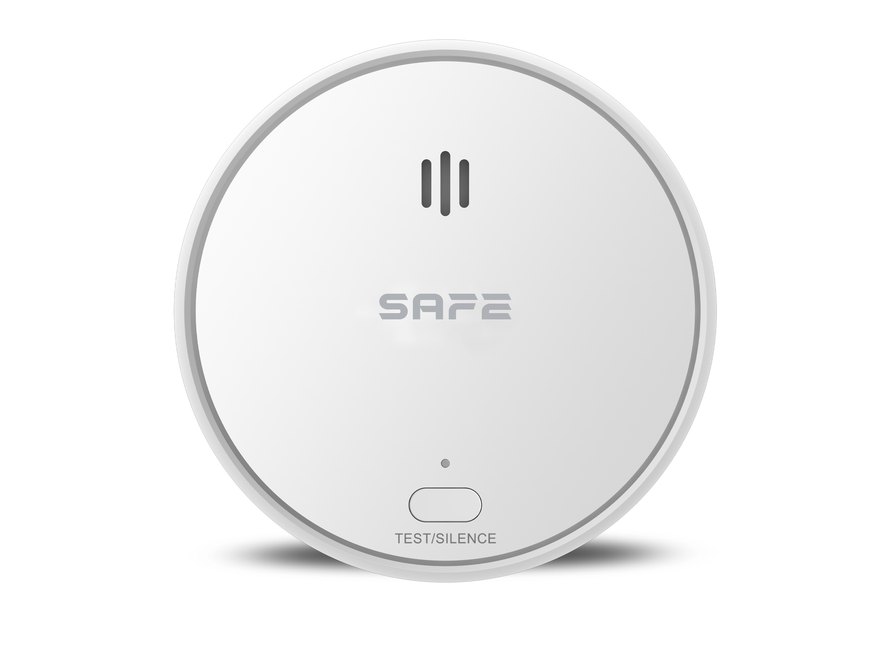
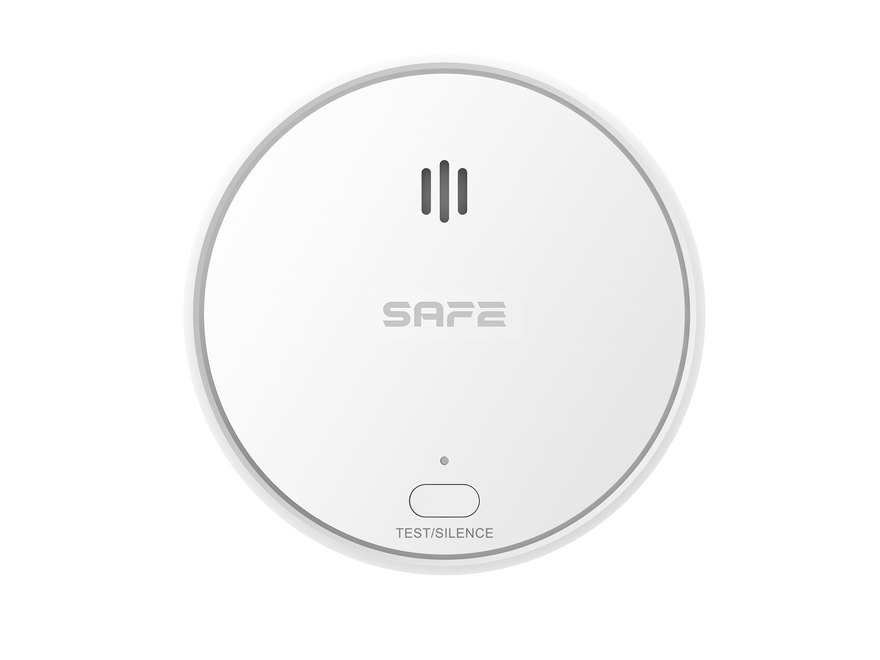
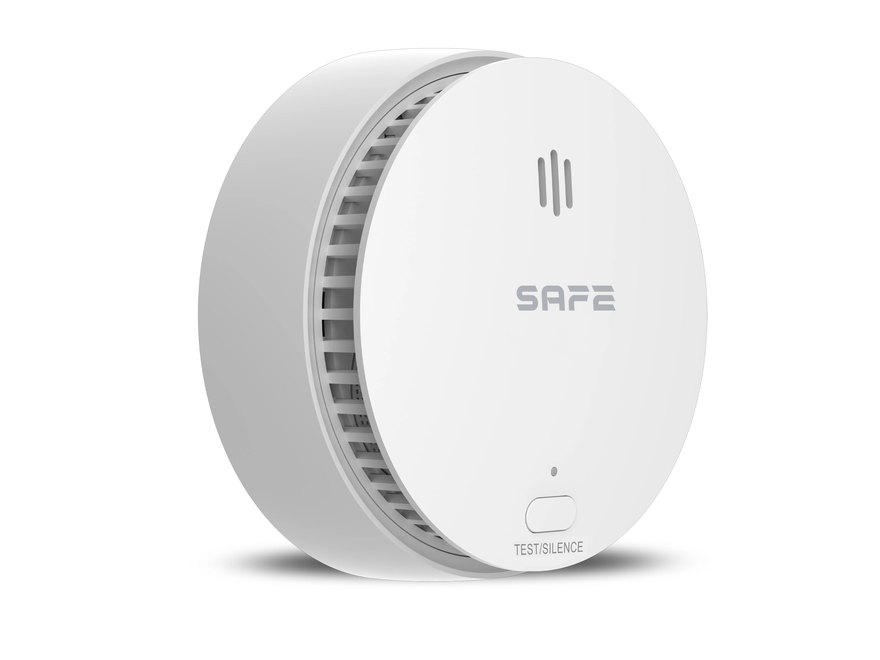
Functional Elements
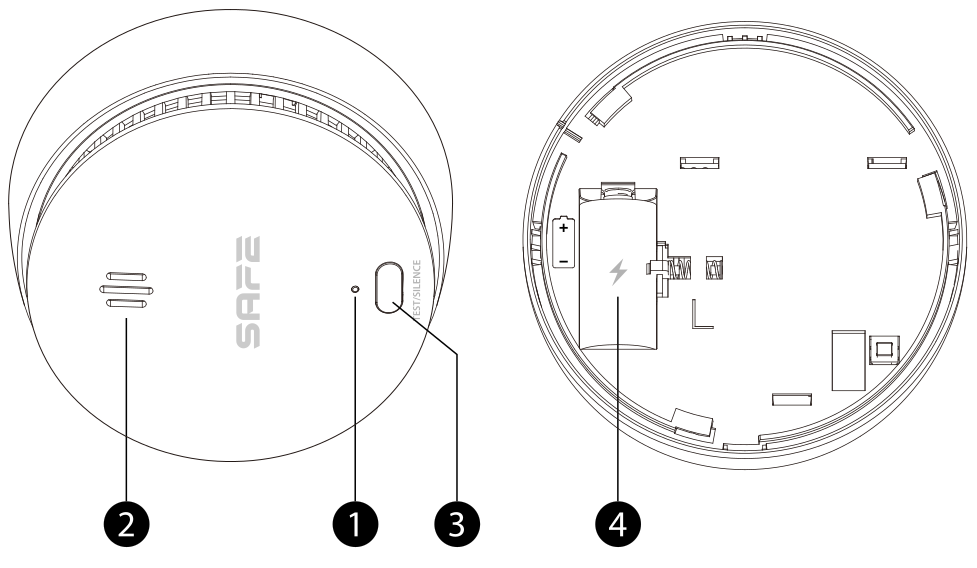
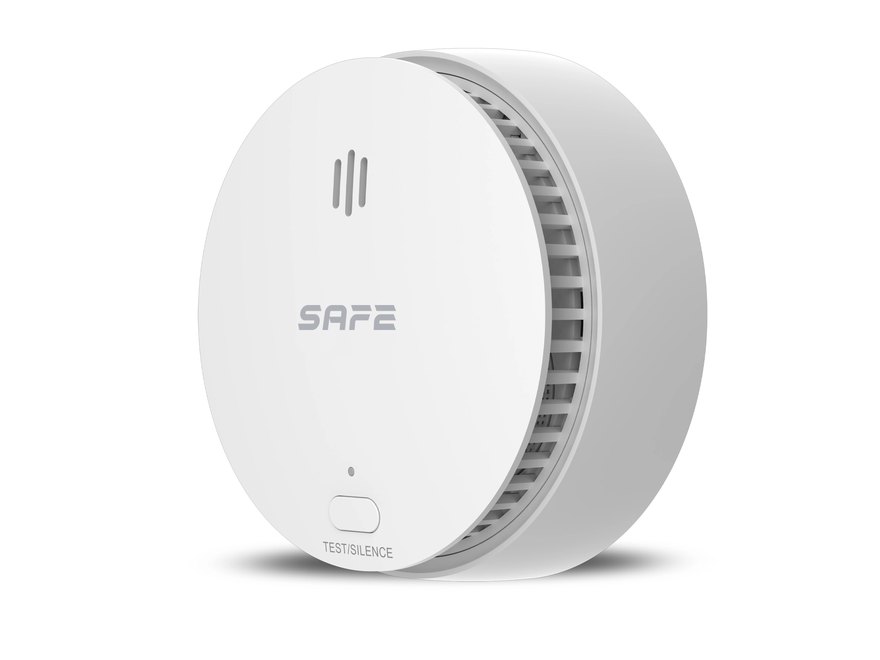
- LED indicator – red and green LED, visually indicates the states of the individual device modes (see Signaling).
- Buzzer – integrated siren, alarm volume 85 dB (A) at a distance of 3 m.
- TEST/SILENCE button – verifies device functionality; also used to temporarily silence the acoustic alarm signal.
- Battery compartment – on the back of the detector, replaceable CR123A battery.
Operating Principle
The wireless smoke fire detector is designed for continuous monitoring, detection, and signaling of smoke. As soon as the smoke concentration near the sensor reaches the alarm level, the detector immediately triggers an acoustic and visual fire alarm signal to inform the user of impending danger. The detector includes an integrated RF module that enables connection and wireless communication with the SAFE hub – when an alarm is triggered, the detector immediately relays the event to the hub, and the user receives a notification in the ProSAFE. The detector can also operate completely autonomously, without connection to a hub.
Dual-spectrum smoke chamber
A dual-spectrum optical sensor with blue and infrared LED sources of different wavelengths is integrated into a dust- and insect-resistant smoke detection chamber. The chamber design is directly connected to the AI SAFE microprocessor, which enables measurement of the concentration of airborne microparticles directly and in real time. This technology can determine the size of volatile particles inside the optical chamber and respond only to a real smoke threat, while ignoring similarly composed water vapor or other fumes.
Protection against false alarms
The AI SAFE microprocessor was developed based on a detailed analysis of the combustion properties of materials and works with a predictive algorithm that compares data from the dual-spectrum optical sensor and filters out potential false alarms in real time. If the recorded data corresponds to liquid particles of water vapor or other types of fumes, the detector will not respond. However, if the dynamics of the data pattern match the actual parameters of solid smoke particles from a fire, the detector immediately triggers a fire alarm.
24-hour protection zone
The detector detects the onset of fire continuously 24 hours a day, 7 days a week, regardless of whether the security system is armed or disarmed.
SIC technology – remote silencing with an IR remote control
The detector has a combined TEST and SILENCE button, which is used both for testing and verifying correct device operation and for temporarily silencing the detector. If you know the cause of the fire alarm activation and need to silence the loud acoustic signal, there is no need to go directly to the detector and press the button on it – SIC technology allows remote silencing of the acoustic signal by pressing any button on a common IR remote control (most remote controls for household appliances, such as a TV).
IZOVAX protection for humid areas
The electronic components and the printed circuit board of the Fire Guard detector are coated with an insulating and protective layer of varnish containing IZOVAX. Thanks to this and to the dual-spectrum optical chamber technology, which distinguishes smoke particles from water vapor, the device can be installed even in very humid environments (near bathrooms, drying rooms, kitchens, or utility rooms) – unlike conventional fire detectors.
SAFE Keeper protocol
Communication with the hub is provided by the encrypted two-way radio protocol SAFE Keeper in the 868 MHz band:
- AES-128 encryption,
- frequency hopping as protection against interference – when signal interference is detected, the user is notified and the device automatically retunes to an interference-free frequency band,
- range up to 1 000 m in open space,
- two-way communication between the detector and the hub.
Adding to the System
Before adding the device
- Install the app ProSAFE and log in to your account.
- Make sure you have a compatible hub added in the app (Hub 2 Plus LTE, SAFE 38300) with a stable internet connection.
- The hub must be in the Disarmed state.
- Insert the CR123A power battery into the detector – observe correct polarity. The detector activates automatically; activation is confirmed by a short buzzer beep and a red LED flash.


How to add Fire Guard
- In the ProSAFE app, open your hub and click Device.
- Click + Add device.
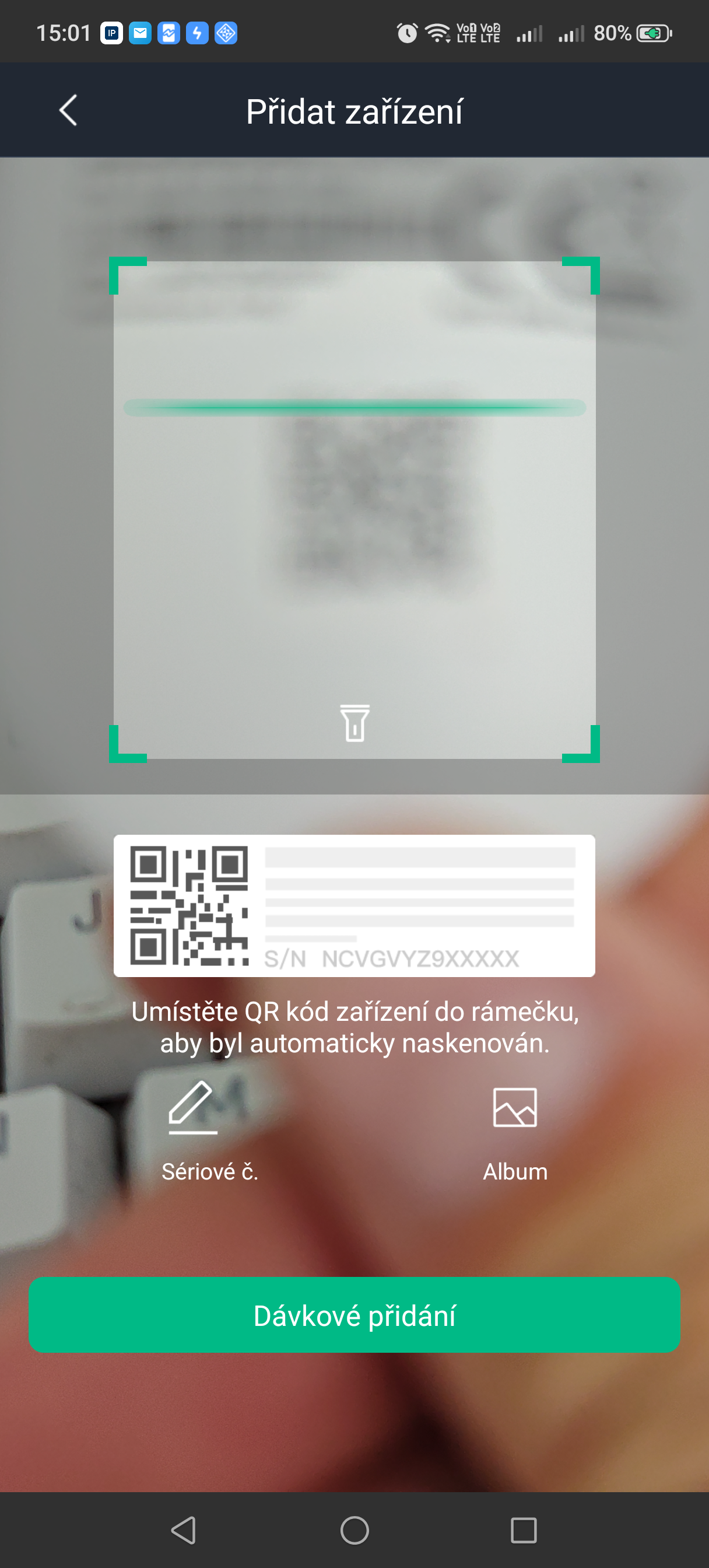
- Scan the QR code with the serial number on the back of the detector and click Next.
- On the accessory screen, select the option Wireless smoke detector and continue.
- Following the on-screen instructions, activate the detector by pressing and holding the TEST/SILENCE button.
- Wait for pairing to complete.
- Enter the detector name, select the area (zone), and click Done.
- Check the signal strength of the connection to the hub at the installation site and test the device's functionality using the TEST/SILENCE button.
States
You can view the current status of the detector in the ProSAFE app by selecting the detector in the device list.
| Parameter | Meaning |
|---|---|
| Online status | Connection between the detector and the hub
|
| Signal strength | Radio signal strength between the hub and the detector: no signal / very weak / weak / good / excellent |
| Battery capacity status | 100 % full / 65 % medium / 45 % sufficient / 15 % insufficient |
| Tamper | Status of protection against unauthorized tampering with the detector or mounting bracket |
| Temperature | Current ambient temperature measured by the integrated temperature sensor |
| 24-hour zone | Always enabled – the detector detects smoke continuously regardless of the system's arming status |
| Connection via repeater | Whether the detector sends messages to the hub via a signal repeater (Yes/No) |
| Firmware version | Current detector firmware version |
Settings
You can adjust the settings in the ProSAFE app: select the detector in the device list and click the edit icon.
| Settings | Value |
|---|---|
| Device configuration | Displays the detector's name, type, serial number, and model; edit the name and save the configuration |
| Area (zone) | Assigning the detector to a system area |
| 24-hour zone | Always enabled – the detector monitors continuously even when the system is disarmed (required by EN 14604) |
| Temporarily disable | Allow (default) / Disable tamper alarm only / Disable |
| Siren linkage | When a fire alarm is triggered, the detector transmits information to the hub and simultaneously activates the siren |
| Video linkage | In the event of an alarm, the event is linked to the video of the selected channel (on hubs supporting camera channels); video channel selection |
| LED indicator | On (default) / off – when off, the LED does not light regardless of a reported fault or detected alarm |
| Transmission power | High / low / automatic – higher power extends range and increases power consumption |
| Signal strength detection | Tests the current radio signal strength between the detector and the hub |
| Cloud update | Remote firmware update for the detector |
| Remove device | Deleting the detector from the system (swipe left in the device list) |
Signaling
| LED / sound indication | Event |
|---|---|
| Short buzzer beep + red LED flash | Device activation after inserting the battery; followed by a brief initialization |
| Green LED flashes once every 60 s | Standby (operating) mode – everything is OK |
| Short buzzer tone + red LED flash | Short press of the TEST/SILENCE button – confirms functionality |
| Red LED flashes once per second + buzzer beeps once per second (repeatedly) | Fire alarm triggered |
| Red LED flashes once per second, no sound | Temporary alarm silencing active (via button or IR remote control) |
| Red LED flashes once every 60 s + buzzer beeps once every 60 s | Low battery – reported approx. 30 days before complete discharge; replace the battery immediately |
| LED does not light | The LED indicator is turned off in the settings |
Choosing the installation location
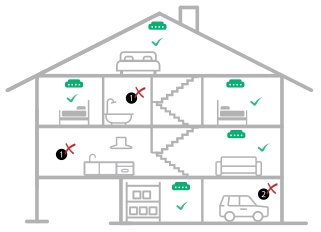
Smoke fire detectors should ideally be installed in every room of the house, except kitchens, bathrooms, and garages. At least one detector should be placed on every floor of the house, including the staircase. Position detectors where you will hear them even while asleep – for example, in the hallway outside a bedroom. Install a detector on the ceiling of every bedroom and in the hallway outside the bedroom.
- If the hallway is longer than 9 m, install a detector at both ends.
- In a multi-story house, install detectors the same way on every floor – this also protects you from smoke rising through the stairwell from a lower floor. In the basement, install a detector on the ceiling at the bottom of the stairs.
Where not to install the detector
- In bathrooms and kitchens – water vapor and cooking steam can trigger a false alarm.
- In the garage – the detector could react to vehicle exhaust fumes.
- In places where the ventilation openings around the detector are not freely accessible – do not cover or otherwise seal them.
- Near fans or other devices connected to air conditioning/ventilation systems.
- Do not use aerosol products near the detector.
Ceiling installation
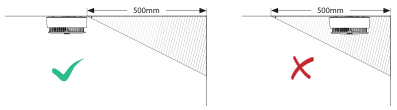
The manufacturer only allows the device to be installed on the ceiling. Install the detector at a distance of at least 500 mm from the corners of the room and the side wall.
Installation on a sloped ceiling
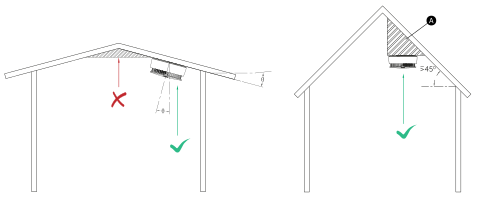
If the ceiling slope is less than 45°, a distance of at least 500 mm from the apex is recommended. When the slope is greater than 45°, a wooden mounting block must be installed (not included).
Installing the detector
- Select a suitable location for installing the fire detector (see Choosing the installation location).
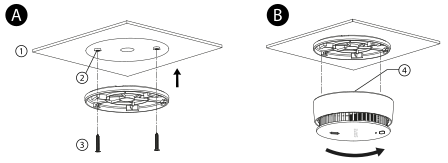
- At the installation site, use the mounting bracket to drill holes (⌀ 6 mm). Insert wall plugs into the prepared holes.
- Secure the bracket using self-tapping screws.
- Stick the information label in your language onto the device.
- Insert the CR123A power battery into the designated slot in the detector. Observe the +/− polarity.
- Insert the detector into the mounting bracket and turn it clockwise until it locks into place.
Functionality Test
After installing the device, replacing the battery, or during regular maintenance, a detector test must be performed to verify its functionality.
- Briefly press the TEST/SILENCE.
- A buzzer tone sounds and the LED indicator flashes red.
| Problem | Solution |
|---|---|
| The detector does not sound the buzzer during testing | If you are testing immediately after first activation, wait a few seconds for the detector to initialize. Make sure you pressed the TEST/SILENCE button correctly. |
| The detector chirps intermittently | Check that the device is correctly positioned (see Choosing the installation location) and perform maintenance (see Maintenance). |
| The LED indicator flashes red and the buzzer beeps every 60 s | The detector's battery is discharged – replace it with a new one (see Battery replacement). |
If the device test does not complete successfully, contact our technical support.
Battery replacement
The detector is powered by 1× CR123A lithium battery (3 H), replaceable, with a lifespan of up to 3 years. A low battery is indicated by the detector's LED flashing and the buzzer beeping for approx. 30 days before complete discharge; the warning is also displayed in the ProSAFE app.
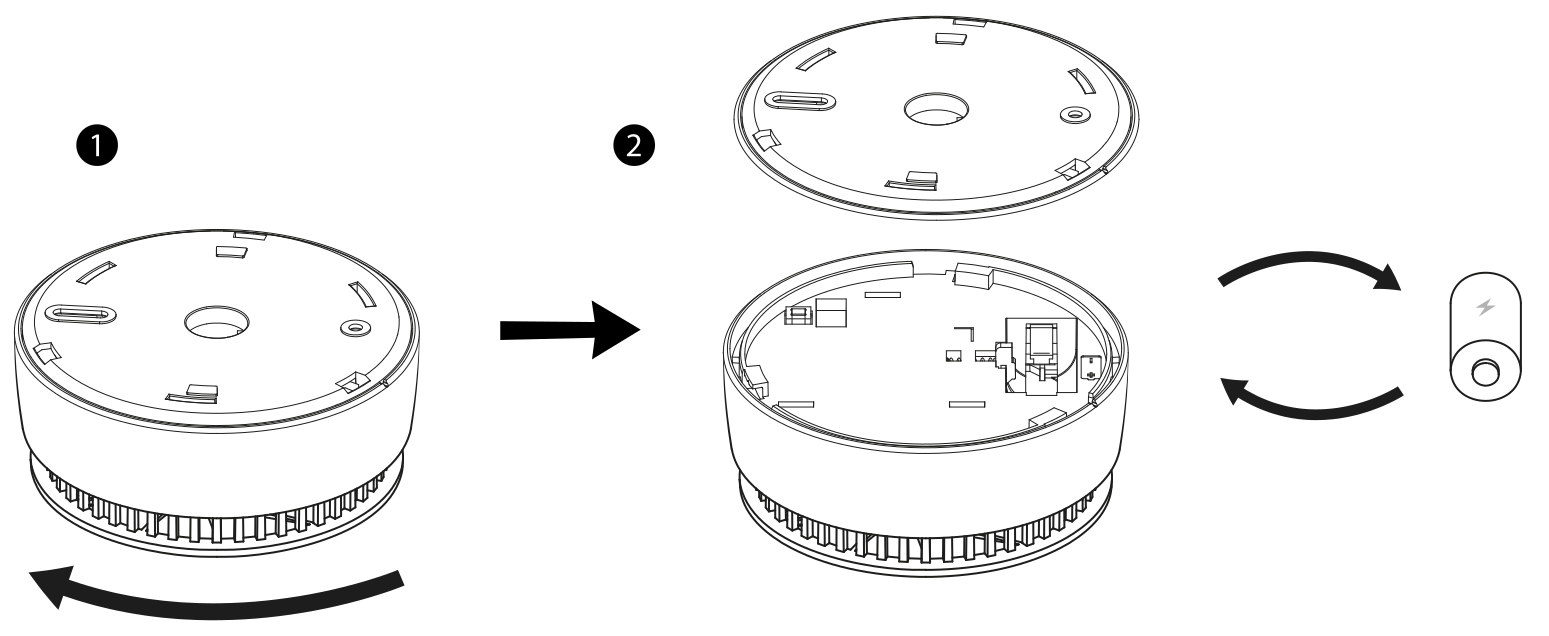
- Turn the detector counterclockwise to remove it from the mounting bracket.
- Remove the old battery and insert a new CR123A battery. Observe the correct positive and negative polarity markings.
- Insert the detector back into the mounting bracket and turn it clockwise until it locks into place.
- Test the device's functionality by pressing the TEST/SILENCE button.
Maintenance
- Test the detector by pressing the TEST/SILENCE button at least once a week.
- Clean the detector at least once a month: remove it from the bracket (by turning counterclockwise), use a vacuum cleaner to remove accumulated dust particles through the ventilation openings, and wipe the outer part with a damp cloth. Do not use cleaning agents or solvents – this risks contaminating the sensor and voiding the warranty. After cleaning, reinstall the detector and test it using the TEST/SILENCE button.
- Do not paint the device – paint may seal the air circulation openings and impair the sensor's ability to detect smoke.
- Do not place the detector in locations prone to vibration and shocks.
- Do not expose the detector to excessive pressure, impacts, dust, high temperature, or humidity.
- Do not place open flame sources (lighter, candle, etc.) on or near the device.
- If dusty construction work is taking place nearby, temporarily remove the detector from the bracket, or cover it for the duration of the work (e.g., with a plastic bag) to prevent contamination of the detection chamber. A covered detector will not detect smoke – always uncover it after the work is finished.
- Do not disassemble the detector or interfere with its internal electrical circuits – any such interference voids the warranty. Servicing must be carried out only by the manufacturer's authorized service.
- The detector must be replaced with a new one 10 years after the installation date – the replacement date is stated on the information label on the back of the detector.
Technical Specifications
| Detection parameters | |
| Detection type | Smoke, fault, low battery capacity |
| Sensor | Photoelectric – dual-spectrum (blue + IR LED) |
| Sampling time | 9 s |
| Room height | ≤ 8 m |
| Detection area | 20–40 m² (for a room height up to 8 m) |
| Detector response threshold | 0.2–0.3 dB/m |
| Max. number of linked units | 24 pcs |
| Protection against false alarms | Yes (AI SAFE predictive algorithm) |
| Signaling | |
| Acoustic | 85–95 dB at a distance of 3 m |
| Visual | LED indicator (red and green) |
| Silencing function | Yes – TEST/SILENCE button, IR remote control (SIC technology) |
| Silencing duration | approx. 9 min |
| Wireless transmission – SAFE Keeper | |
| Carrier frequency | 868.3 MHz |
| Communication type | Two-way |
| Communication distance | Up to 1,000 m in open space |
| Encryption | AES-128 with rolling code |
| Frequency hopping | Yes (automatic) |
| Interface and functions | |
| Indication | Red and green LED |
| Control Devices | TEST/SILENCE button |
| Temperature sensor | Yes |
| Remote update | Yes (cloud) |
| Low battery notification | Yes |
| General | |
| Model Designation | SAFE 38230, white version |
| EAN code | 0728204234822 |
| Power supply | 1× CR123A battery, 3 V, lithium (replaceable, included) |
| Current draw | Standby ≤ 35 µA; alarm ≤ 35 mA |
| Battery life | 3 years |
| Operating temperature | −10 °C to +55 °C |
| Operating humidity | ≤ 95% RH (non-condensing) |
| Storage temperature / humidity | −20 °C to +60 °C, 5–95% RH (non-condensing) |
| Dimensions | ⌀ 98 × 43.1 mm |
| Weight | 140 g net (with battery) / 282.5 g gross |
| Housing material | PC + ABS |
| Installation | Ceiling only |
| Device service life | 10 years from the installation date |
| Compatibility | Hub 2 Plus LTE (SAFE 38300) |
| Certification | CE; TÜV; EN 14604:2005+AC:2008; EN 62479:2010; EN 50130-4:2011+A1; EN 301489-1 V2.2.3:2019; EN 301489-3 V2.1.1:2019; ISO 7731 |
Package Contents
- Wireless smoke fire detector – 1 pc
- Self-tapping screw – 2 pcs
- Wall plugs – 2 pcs
- Mounting bracket – 1 pc
- User manual with a set of information labels – 1 pc
Safety Notices
- Before use, read this manual carefully and keep it for future reference.
- Under no circumstances ignore the detector's alarm – doing so could lead to serious injury or death.
- Exposing the detector to high or low temperatures, or high humidity, can significantly reduce battery life.
- Before using the device, make sure the detector is correctly installed in the mounting bracket and its power has been activated.
- Transport, use, and store the device under the humidity and temperature conditions permitted by the manufacturer.
- Do not expose the product to water or moisture, dripping or splashing water. Do not insert any objects into the ventilation openings and do not cover the product.
- This detector is designed only to indicate the presence of smoke – it is not designed to detect carbon monoxide (CO), flammable gases, or other hazards.
- Installation and handling of the device must always comply with local electrical safety and electric shock protection requirements.
- Do not disassemble or modify the detector – in the event of a fault, contact support; servicing is carried out only by the manufacturer's authorized service.
- The device is not intended for use by persons (including children) with reduced physical, sensory, or mental capabilities without supervision or instruction from a responsible person. Make sure children do not play with the device.
- Keep batteries out of the reach of children. Do not dispose of them in fire, crush them, or cut them open – risk of explosion.
- Do not dispose of the product with regular household waste – hand it in for recycling through the electrical equipment take-back system.
What to do in the event of a fire alarm
- Wake young children and immediately leave the endangered area via a pre-planned escape route. Do not waste time getting dressed or collecting valuables.
- Never open interior doors without first touching them. If a door is hot or smoke is seeping through the gaps, do not open it and use an alternative escape route.
- If you find yourself in an area with smoke concentration, stay low to the ground and breathe slowly, ideally through a dampened cloth.
- Once you are out of the building, go to the designated assembly point and make sure everyone is accounted for. Do not re-enter the building until the danger has passed.
- Contact the integrated emergency system only after you are safe.
Warranty
The SAFE Fire Guard device is provided with a warranty 36 months from the date of sale. The warranty does not cover batteries or defects caused by failure to follow the instructions in this manual, damage, modification, improper use, or improper maintenance and placement of the device.
If you experience any problems with the device, contact technical support first – most situations can be resolved remotely.
Gallery
Need Help?
SAFE HOME europe technical support:
Email: info@safe-home.eu · Phone: (+420) 581 222 262
Website: www.smart-safe.eu